Parcels, Paper and a Pudding Bowl: Helping Little Ones Find Thanks Without the Prompt
There is a particular December scene that many nursery parents will recognise. A relative arrives with a parcel wrapped in paper and enough Sellotape to survive a small flood. Your three-year-old is delighted — but mostly by the ribbon. The relative waits. You wait. Then comes the familiar nudge: 'What do you say?' And your child, who was perfectly happy a second ago, suddenly finds the floor extremely interesting.
It is not rudeness. It is not a parenting fail. For under-fives, gratitude is still a big, abstract idea being built slowly out of everyday experiences. And when we prompt in the middle of an exciting or overwhelming moment, we can accidentally turn a warm exchange into a test. This Christmas, it is okay to take the pressure down a notch.
Why the prompt can miss the mark
Under-fives are concrete learners. They understand what they can see, touch and do. 'Thank you' is a social script, and scripts take practice. In the moment a gift is handed over, a child is also managing excitement, attention, perhaps shyness, and the presence of an audience. Asking them to produce the right words on cue asks a lot of a brain that is still learning to manage impulses and read social situations.
That does not mean manners do not matter. They do. But gratitude is not the same as a performance. If a child is repeatedly quizzed — 'What do you say? Say thank you. Go on' — they may learn that gifts come with a small audit. The warmth can get lost behind the correction.
What gratitude looks like at three
It rarely looks like a polished sentence. It might look like a child clutching a new book to their chest. It might be a smile, a hop, a sudden desire to show Grandma where the toy lives. It might be a scribbled picture, a sticky hand offered for a hold, or a child saying nothing at all but staying close.
Children often feel thanks before they can package it into words. Language and social confidence vary enormously at this age. Some children will happily chirp 'thank you' to a stranger; others need time, a familiar adult, or a quieter room. Neither child is more grateful than the other.
Swap the quiz for a commentary
One gentle shift is to stop asking and start narrating. Instead of 'What do you say?', try: 'Look at that lovely book from Auntie. I am going to say thank you — thank you, Auntie.' You are modelling the words without putting your child on the spot.
You can also offer a low-pressure choice: 'You could say thank you, give a smile, or show Auntie where it goes.' Then let it go. If your child does nothing, that is information, not defiance. Later, away from the audience, you can practise: 'Shall we draw a thank-you picture for Auntie?'
It helps to prepare relatives too. A light sentence before the visit can work wonders: 'We are practising thank-yous in our own way at the moment — don't worry if she is quiet, she is usually thrilled once she has had a minute.' This is not making excuses. It is giving your child room to be a person.
Make thanks something you do together
Gratitude grows best through experience, not instruction. At Happy Hearts, we often see children learn warmth by doing something alongside a trusted adult: stirring, sticking, choosing, handing over. The same can happen at home.
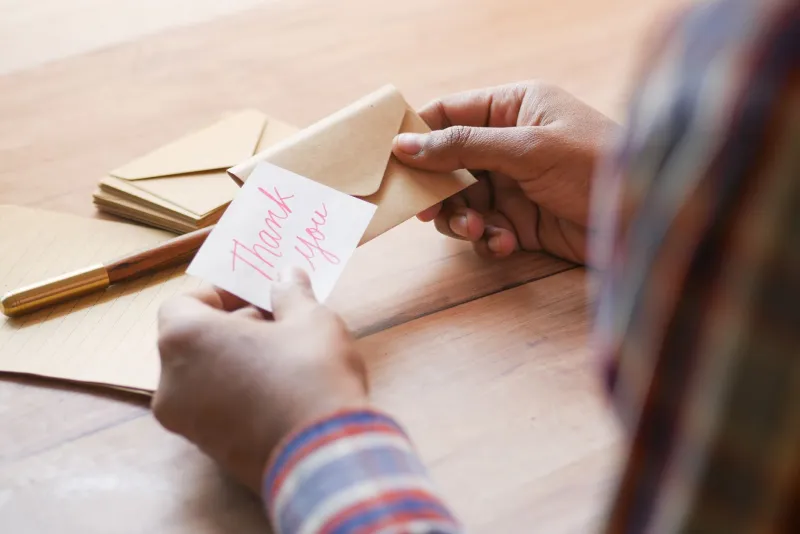
Try a thank-you drawing. Your child scribbles; you write the words underneath: 'Dear Grandpa, thank you for my tractor. Love from...' The drawing does not need to be a masterpiece. It is the act of making something for someone else that matters.
A kindness jar is another simple idea. Keep a jar and a pile of pom-poms, paper leaves or odd buttons. When someone does something kind — a friend shares, a sibling helps with wellies, a neighbour says hello — add one to the jar and name it out loud: 'That was kind when Noah passed you the bricks.' At the end of the week, tip them out and remember together. It is not a reward chart. It is a gentle way of noticing.
You could set up a post-box game with a cardboard box and old cards. Post pretend letters. Thank the postie. Thank the person who made dinner — even if dinner is fish fingers and a pudding bowl. Children learn that thanks is part of ordinary life, not just a Christmas performance.
Manners still matter — just later
Wanting your child to be considerate is a good instinct. The trick is to teach manners without shame. Keep using 'thank you' yourself. Thank your child when they help: 'Thank you for putting your cup in the sink.' Name kind acts when you see them. If your child snatches a gift, you can step in calmly: 'We need to ask first. I will help you.' That is teaching, not shaming.
Later, when the dust has settled, you might say: 'Grandma looked happy when you showed her the box, didn't she?' You are joining the dots between their action and someone else's feelings. That is the long game.
A note for the family group chat
If relatives prompt your child, try not to see it as criticism. Many adults were raised with 'what do you say?' and it comes from a kind place. A gentle reply can redirect without a row: 'We are letting him find his own way to say thanks — he might just show you the present instead.' Most people will understand.
And if you are the one receiving a gift, model thanks yourself. Children learn plenty from watching the adults around them be warm to each other.
What to do in the moment
Pause. Breathe. Resist the urge to perform for the room. Name the feeling if it helps: 'You are excited. It is a big parcel.' Model the words. Offer a choice. Then move on — no lecture, no post-mortem in front of everyone. Later, you can revisit with a drawing, a card or a simple 'Shall we tell Grandma what we did with it?'
By Christmas 2026, your child may not deliver a flawless thank-you. They may still hide behind your legs when the doorbell goes. But they can learn that gifts come with warmth, that kindness is noticed, and that they are not being graded on their manners. That is a much better gift to give them — and it does not need wrapping.